ITANA Face 2 Face Case Studies

Duke University

http://oit.duke.edu/tag/

Tech Architecture group at Duke is charged:

  • to track emerging technology and raise issues for the CIO’s consideration
  • review major decisions
  • integrate into the project management lifecyle
  • pay attention and champion certain solutions

Developed small set of principles – few enough that they could remember them around four areas:

  • Data
  • Infrastructure
  • Services
  • Support

Each of these areas are highlighted in each principle’s page (http://oit.duke.edu/tag/principles/p-robust-systems.html)

The principles:

  1. Robust Secure Systems
  2. Link don’t copy
  3. Design for scalability
  4. Design for information lifecycles (not only the data but the overall system)
  5. Adapt to realities of people and technology (has to work in real life)

There is tension between all of the principles. You are picking a failure mode when/if you don’t meet a principles.

TAG drafted the principles. Focus groups used to refine the principles. The “adapt to the realities” principle came from the focus groups. Did an OIT-wide staff survey. Then followed a communications plan to evangelize the principles. They showed practical application via case studies – looked at situations that went badly or tough decisions that had to be made. The case studies are very valuable for communications and for the change management. They chose failures that where inside the group so that they would be criticizing themselves.

They also use Issue Reviews when there is a failure (http://oit.duke.edu/tag/issues/index.html). Each write-up has a list of recommendations with the principle highlighted.

The idea is build a volume of case-law and to evaluate the principles. “You’re making stories… the legend that becomes part of the culture”.

UW-Milwaukee

Started the planning process in 2005-2006. Looked the leadership and the way that the serve campus. They also help support the UW-System.

Targeted the information flows between and within the academic, research and administrative areas. Engaged the leadership.

They hired staff with EA experience and repurposed staff with expertise. They then looked at frameworks to take advantage. The liked the TOGAF framework but streamlined it and made it more light-weight.

The EA Team has:

  • Chief Process Architect
  • Enterprise Data Architect (Michael Enstrom)
  • Operations Architect
  • Application Integration Architect
  • Security Architect
  • Network Technology Architect
  • Web Architect
  • Deputy CIO

Developed Architecture Principles in four areas; Business, Data, Application, Technology. Develop “IT Guiding Principles” for centralized and decentralized IT-Oriented staff (“how we’ll function”). Defined the activities that we will follow together to put the Architectural Principles in place. Almost an SLA with the business partners.

Now doing a data/application/process inventories – huge pain, a lot of work. Trying to capture legacy information before people retire.

A lack of a consistent approach to requirements gathering leads to solutions that aren’t based on deep understanding. The role of agile approach is to do it in smaller chunks. This helps align the requirements with the end-users needs. They have used the IIBA Requirements Management methodology. The CIO is paying for the training of people outside of IT so they all speak a common language.

They are looking at an “Emerging/Accepted/Best Practices” approach. Looking a broad suite of standard best practices. Evaluate the standards and see what they want to use.

Working on a method to bring every one to the table set priorities for funding and projects.

Saint Louis University

2006 – was getting a lot of things done but they weren’t connected. Lot’s of talk about flexibility and agility. There was a lack of change control with “heroism at the interfaces”. Lot of big projects going with and showing success: network, info shield, DHCP, Banner ERP upgrade, IDM. The CIO said, “show me some ROI” when she created her EA group.

Drivers for EA: mitigation of risks with the Banner Upgrade, regulations (SOX), lack of documentations. Started with the ITS shop first.

Governance included the 19 architects (domain and EA architects). The things that worked: the focus on People, Process and Technology. The PIM (Product Item Master) and the quarterly report of the PIM. Building relationships has been a focus for the past year or two. Created an Enterprise Infrastructure Working Group to manage the desktop image.

Using procurement to document savings.

Next Steps:

Architecture Gaps – they have reference architectures and the PIM but there are steps and layers missing between the two,
Governance Gaps – missing ties between strategic goals and the local technical choices,

The Control of the Work statement: what does that mean? Do you think the EA group will control the work? Means enterprise system / standards type context under the control.

How do we articulate the importance of “Architecture” regardless of the leadership and changes in leadership?

Technorati Tags: , , , , ,

ITANA Face2Face Tools of Trade

UC Davis

http://vpiet.ucdavis.edu/

Created an Administrative Services Map with eight domains. Each domain has a Domain Convener. All the Domain Conveners gather on a single governance board.

  • Academic Personnel Adminstration
  • Enterprise Asset Management and Planning
  • Student and Curriculum Support
  • Finance
  • Information Technology
  • Alumni and University Relations
  • Research
  • Payroll and HR

Just bringing this fruition.

Currently moving to Kuali Financials – this is a “big rock” project that they stage. Above this is their SOA, ESB and Infrastructure layer. With IdM above that. Then Portal.

Use the roadmap to help guide the School and Department works. Hope to align the work in the School and Departments with the roadmap.

Having a transparency, rich communication and agree on principles helps with the alignment across domains and the schools and departments.

If you look down the road, you could see that the IT domain would grow as more stuff moves into the infrastructure layer. This would also allow for more modular developments.

The roadmap is application centric – the infrastructure layer should have its own roadmap.

U Chicago

Protege based ontology for mapping the relationships between Applications, Platforms, Networks. They have a defined a set of relationships: Hosts, Is-part-of, is-server-to, etc.

Produces a cool drill-able graph of relationships. The relationships have structural properties.

They have captured 1300 relationships. They have limited things to objects that are production.

The production shop is looking at this tool for mapping the flows of data files in batch jobs.

Limited to the amount of information that they can reasonably gather and manage with a 6 month refresh rate.

Technorati Tags: , , , , ,

Spring in Wisconsin – weather runs amok

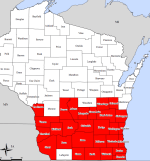
UPDATE: June 25th. We now have 28 counties declared as disaster areas by FEMA.

Wisconsin Disaster Area Map

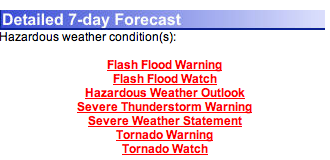
When we get serious Spring weather, we get weather sites that look like this:

  • 7 Warnings, Watches and Statements on the Weather.gov forecast
  • A weather map that is covered, jigsaw like, with areas of watches and warnings across the surrounding 25 counties. Nary a gap between the warnings and
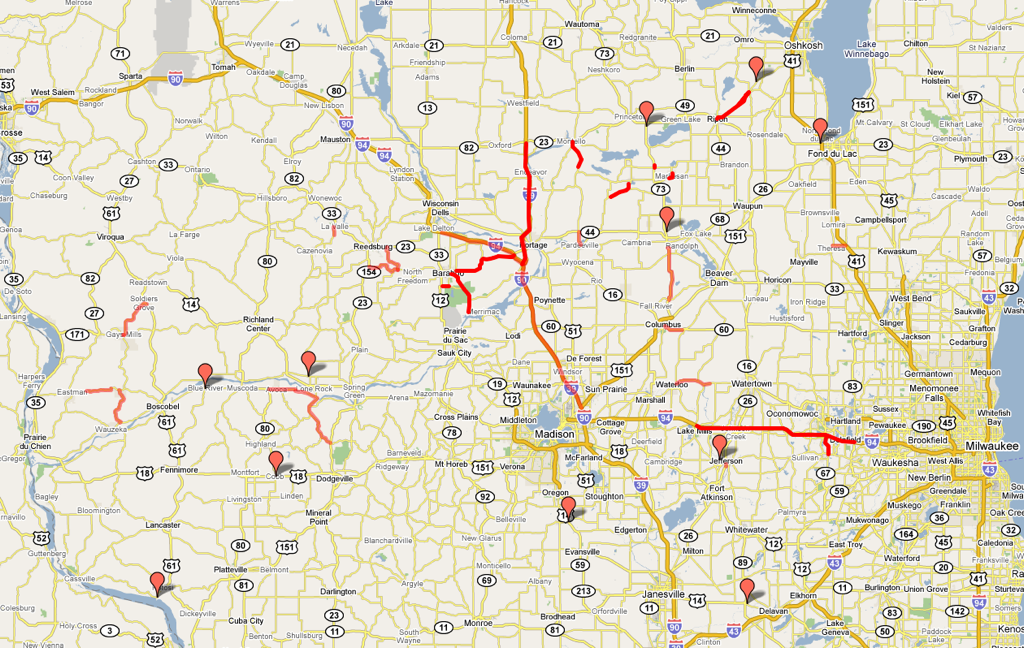
  • A Wisconsin DOT incident alert map with 38 road closures due to flooding the next day.


We had 7 tornado warnings in town Thursday. I spent a lot of time checking the weather on WKOW. Two tornados went past south of our house about 20 miles.

EDUCAUSE Live event recording has been posted

The recording of my EDUCAUSE Live presentation is now available on the EDUCAUSE site. EDUCAUSE Live! IT/EA in Academia recording.

Lola gets her Spring haircut

Here are photos from Lola’s Spring clipping. It’s always fun to clip her after she has grown out all Winter. It’s like having two dogs in one. We always seem to pick a windy day to clip her coat. I feel a fine patina of fur covering my exposed skin. The process is to bath Lola the night before, clip her the next day, put everything you’ve got on into the laundry immediately and then wash up because you are covered in clippings.

She is very good about being clipped. She even wags and waits to be put up on the table. You can tell that she is thinking, “Oh boy. I like this table. This is my table. I’m the center of attention and I get an endless stream of good stinky treats.” I consider clipping Lola to be 30 minutes of controlled shedding in the place of my choosing and the time I pick. We will clip her once a month now through September or October. Then she gets to grow out for the Winter all over again.


Before pictures:

A very fuzzy dogWhat eyes

After pictures:

Ena and Lola after clippingPost Clipping She has eyes


First from the Farmer’s Market

Last night we cooked the first dinner of the season from the Farmer’s Market. All of the food came from the Dane County Farmers’ Market on the Square except for the Mint Newman-Ohs. We made grilled trout with a parsley pesto (italian parsley, garlic, olive oil, salt and pepper), grilled fingerling potatoes (par-boiled, rubbed with olive oil and salt then roasted over the coals till crispy on the outside) and steamed spinach. Lola helped watch over the grill. Here are a few pictures.

IMG_1776.JPGIMG_1778.JPGLola

Digital Neighborhoods – Guiding design

Second LifeDigital neighborhoods seem like a powerful tool for discussing technology and its impact on users (students, staff, researchers, etc) and the concept adds interesting new requirements to projects. Getting a good understanding of your users’ digital neighborhoods can guide design and deployment of new technologies and help predict impacts on the users themselves. Understanding how they move in their neighborhood, where they travel frequently and what places are stable over time, provides insight into the key places you should try to place application.
I came upon Jeff Swain via Twitter which led me to his blog-post about his digital neighborhood. I was wandering in my digital neighborhood and into the surrounding areas when I found his link. Jeff talks about reading David Weinberger’s Small Pieces Loosely Joined. To quote Jeff’s post:

As Weinberger points out space on the web doesn’t work that way. Distance is measured in hyperlinks and proximity is created by interest. In other words, each of us gets to create own own space on the web. Your own neighborhood, if you will, filled with the places you find interesting…. So this got me to thinking, What does my digital neighborhood look like? What seemingly disparate places are loosely joined (pun intended) just because I happen to be interested in them?

Jeff then goes on to do an analysis of his digital neighborhood.

As I read Jeff’s piece, I began to think about the value of understanding digital neighborhoods. If we understood our incoming students’ digital neighborhoods, it would give us a better understanding of how to reach them, what their interests are and places that we should think about pushing content into. One example that we have in place is in Facebook. We now have an emergency notification group and system in place in Facebook. Our leadership can push out notices via Facebook, into the user’s neighborhood.

Another example is our increasing use of RSS feeds for various applications and calendar feeds. This lets users pick up the content and move it to their own neighborhood. I have a calendar feed for our corporate calendar system integrated into my Google homepage. I can check my work calendar while checking personal email, local news and recording my workouts. The fact that my calendar appears among my personal tools means I track changes to my calendar much more closely when I’m at home doing my personal things. In some ways, Google’s custom homepage is like strip-mall with a few anchor stores (Mail, Calendar, Google Apps) and a lot of empty store fronts that you can fill with your own shops.

The value of these virtual malls, is that users can aggregate enough of their own personal content and applications that it makes it worth the trip. Every time you go on the web, you have thousands of possible places you could visit. Yet, you visit a select few. If we continue with the physical store/neighborhood metaphor: Every time you go shopping, you could go to any store in town but you go to a select neighborhood (like our State Street) because of the variety of interesting shops or to a given store because of the shop has some unique value (low price, selection, the one thing you can only find at their store). A similar thing happens when we deploy applications. Users are expected to visit that application because of the unique value it brings. When we bring up applications that are separated from their current digital neighborhood, it is like building your store in a new mall well out of town. The users have to have some reason to visit. The value has to be higher than an application built in their neighborhood or built such that it can easily be included.

This suggests to me at least, that we need to think about our users’ current digital neighborhoods and how we can integrate our new applications and services into those neighborhoods. RSS feeds are a low risk and fairly simple way to move content into their neighborhoods. Facebook groups and applications could reach into the students’ world. Portlet type applications that can be put into existing enterprise portals or into sites like Google’s homepage allow richer interaction. Finally, if if has to stand on its own, it better have unique value that makes it worth the trip.

Technorati Tags: , , , , ,

Eat your vegis or Have A Little Green Tree – getting EA into the Enterprise

I was thinking about how, when I try to get buy-in for doing Enterprise Architecture as a holistic thing, I tend not get very far with the campus. But, when I parse out little EA bits, they catch on. I was thinking about this in terms of the metaphor: Getting Kids To Eat Vegetables. Before I go on further – this is not meant to demean the campus community nor do I mean to imply they are childish. It is just a good metaphor for my understanding what is going on around me.

There are two approaches to getting kids to eat vegetables. The first is the top-down, holistic approach where you explain that vegis are good for you. You talk about good food and bad food and vitamins and healthy eating. This is the Enterprise Architecture as a holistic practice approach. You talk about why we need to do Enterprise Architecture and the benefits or reducing redundancy, getting a handle on what we are doing and why, setting a clear(er) roadmap for the future. Our institution, like most kids, don’t really get the point of the discussion nor do they buy into the argument.

The second approach (re: kids and vegis) is to sell them on “eating a little green tree” also known as broccoli. Then convincing them that peas with mint are pretty good cold. Once they are eating three or four types of vegis, you can explain the vegetable concepts and start in on nutrition. “You know, carrots make it so you can see better in the dark. That’s pretty cool that a carrot can give you night vision. Let’s eat carrots each night this week and see if on Saturday, we can see better in the dark.” You can get buy-in for the short-term cool gain of one vegetable type.

This is what seems to be working for us architects here at UW-Madison. I have slowly started pushing out some different artifacts and practices. Each one is catching on based on its own merits. We have various places starting with principles using the TOGAF format for Principles .

I’ve started to get people interesting in applying the NIH EA Brick Diagram to various projects and technologies.

This is an interesting approach to “doing enterprise architecture”. I’ll need to focus more on small acceptable bites that are examples of why you should do EA at large. Get them eating broccoli, peas and carrots and then talk about nutrition.

Technorati Tags: , , , , , , ,

EA in Academia Presentation

Below is a repackaged copy of my “Enterprise Architecture in Academic Environments” presentation that I gave at EDUCAUSE Mid-West Regional Conference 2008. It is packaged as a Quicktime Movie.