
Author Archives: jimphelps

Unknown's avatar

About jimphelps

Chair, ITANA Enterprise Architect, Sr. IT Architect; UW-Madison

Blue Sky to Ground part 1


Soaring

Soaring

I’ve been working with our CIO on the I.T. strategic planning initiative.  At the same time, I’ve been working with the Technical Directors and Operational Directors on planning at the technology level.  They have been creating a map of what technologies are used to support our services.  I’ve had my head in the blue sky of the strategic planning process while I’ve also had my hands in the dirt of the technology mapping.   I keep coming up against the issue of how to connect the blue-sky of the strategic plan with the down-in-the-dirt technology planning.

Finding a process and methodology to connect the sky to the ground has taken up a lot of my mental cycles recently.   The following is my take on a method to connect the strategic planning to the technology planning. 

1.  Strategy to Capabilities

The first step is to take the general directives of a strategic plan and have them expressed in terms of capabilities.   I see this work being done by leadership as part of a collective planning exercise.   As an example, a strategic initiative might be: Classrooms and learning spaces will be equipped with a base set of instructional technologies.   This strategic direction then needs to be interpreted into a set of defined and measurable capabilities.    A leadership team would be charged with determining the capabilities that would meet this strategic direction.  The capabilities should be measurable.

For example, the capabilities might be:  Multimedia Projection, Student Response Measurement and Lecture Capture

We could survey all rooms and learning spaces and get measures of current state (for example: 65% of rooms meet the projector capability, 15% meet the student response and 10% meet the lecture capture capability).   We could then decide priority – which is more important lecture capture or student response – act on those priorities and measure improvement.

2. Capabilities to Services

The next part of this to map our services to the strategic capabilities.  Some services support multiple capabilities (Hosting Services, Identity Management Services for example).  Some capabilities may not have a supporting enterprise service.  A capability that does not have a set of supporting services might indicate a gap in the enterprise.  For example, there may not be a matching Lecture Capture Service that provides the Lecture Capture capability.  This might be done in an ad hoc fashion or it might be missing completely.  This gap in the enterprise service would be worth evaluating to see if the capability is being delivered effectively in the current structure.  If not, then we might want to look at developing an enterprise-wide Lecture Capture Service that supports all of the classrooms.  

3.  Services To Technical Roadmaps

This is where we use the brick diagram in our planning.  The brick diagram captures the technologies that support a given service.  The brick captures what is current state (those technologies currently in use), what is tactical (what will be used for the next 0-2 years), what is strategic (on the plans to use 2-5 years out), what is in containment (no new development), what is in retirement (being stopped) and what is emerging (interesting trends that may move into the tactical or strategic realms in the future).  

These brick diagrams are created and maintained by the service owner – that is the group that manages the service being provided.  The bricks let the service owners and the service teams grab a snapshot of their current state and their strategic plan for the next few years – what they will leverage, what they will stop, what they are watching and what they want to move to – in a simple format.
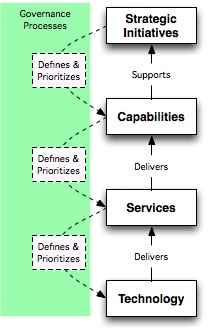
 

Core Planning Stack from Tech to Strategy

Core Planning Stack from Tech to Strategy

This set of relationships is managed by a set of governance process that define and prioritize the layer below.  

At the lowest level, the service manager or service team usually defines and prioritizes the technology they use to deliver that service.   This is the layer that is captured in a brick diagram.  They should also describe the capabilities that are delivered by their service and which strategic directions they support.  

At the top level, senior leadership should work to refine the strategic directions as measurable capabilities that want to see delivered.  

The mid-level governance is a gap in our institution.  It is probably filled by project prioritization processes and budget processes.  I’ll talk about that in part 2 of this post.

Uncommon Thinking…

From the Flickr stream of Bre_Pettis

From the Flickr stream of Bre_Pettis


I was chatting with a colleague about the new EDUCAUSE slogan, “Uncommon Thinking for the Common Good” when I realized that the saying encapsulates one way to think of my work as an I.T. Architect.  “Uncommon Thinking for the Common Good” is what I try to foster in the teams that I work with.  I’ll explain this in two parts “Uncommon Thinking” and “for the Common Good”.

Uncommon Thinking:

I try to break people out of their daily routine and their comfort zone.  For instance, I have sat in meetings where a team is supposed to develop a new user interface (UI) for a new application.  I’ve watched as team redraw the UI for the old application, that they use day-in and day-out, as the solution for the new system.  I’ve also seen teams “re-think” how a business process could be done.  The end result was an automated version of the current process.  The new implementation of the old solution substituted emails for people running around with paper.  They are following the same steps, replicating the same authorizations and sending the same forms often without asking “why this form” or “why this person” or even “is this necessary at all”.   My job is to get them to question their old ways of doing things.

People like what they know.  They understand what they use daily.  But advancement comes when we change and disrupt routines, not when we replicate them into a new technology.  You have a telephone book at home with White Pages for people and Yellow Pages for businesses.  Changing that into two Word files you can print doesn’t bring great advancement.  It might be easier to carry only the pages you need but that doesn’t really improve the process.  Search capabilities are a big improvement.  Rethinking how you use the information, such as mapping businesses onto maps so you can find restaurants near your hotel, that brings advancement.  The routine of grabbing a book and looking something up is thrown out.  The new routine is to grab a laptop, look for wireless and Search.

I often introduce myself to new teams saying that my job will make them uncomfortable because I will ask them to throw out what they know and what they are comfortable with.  I tell them I will challenge their assumptions.  I say this not because their assumptions are wrong but to make sure their assumptions are correct and we accept them for the right reasons.

I love the fact that the Web 2.0 explosion is going on.  There are so many examples of “other ways to do things”.  I bring these examples and ask, “why can’t we do this instead?”  I show them Netvibes and ask, “can we make our pages this flexible?”  I show them Etsy’s Find By Color page and ask, “can we make creative ways to search like this?”  I show them The Northface catalog and ask, “should we have filters to help people search like these?”


Etsy Color Browser

Etsy Color Browser


It’s not that I think we should have a UI that looks like any of these sites but I want to break the team’s mindset and get them to start thinking about all of the rich possibilities.  I want them to work with a blank canvas and a rich palette of colors.  I want them to really get imaginative in their solutions to the problems.

I had a watercolor instructor that I worked with at UC Santa Cruz.  We were painting in the woods one day.  Everything I produced came out flat, boring and uninteresting.  They were awful, actually.  I was having a terrible time.  He came by, had a look and asked how it was going.  I grunted out my disgust.  He said, “Give me three paintings, but you can’t use any browns or greens at all. No earth-tones.”  I’m sitting in a forrest of browns and greens.  I was forced to paint purple and blue trees and red ferns.  At first it was very uncomfortable and I was very hesitant.  The first attempts were also awful.  But then, it became fun and playful and the paintings improved.  I was forced to let go of “how it is” and instead I had to play with “how it could be”.

That is the uncommon thinking of the Architecture practice.  Letting go of the how it is and thinking about how it could be when we start with a blank canvas and rich palette.

For the Common Good:

The other aspect that I deal with on teams is the narrow focus of their solution.  Often, the solutions that are put forth solve the very local needs of the group of people sitting around the table.  My work is to ask, “how does this fit with the broader issues that the people deal with daily?”  “What does this solutions do to actually help people?”  “What impact will this have on them?”  Not all solutions should be broadened and generalized to solve a larger issue but we should consider their larger impact. 

Every application must fit into an already rich application environment.  No application is truly a silo-application anymore.  Someone has to use it.  That someone already has a username and password if not several.  That someone already has a day that is full of tasks and applications.  That someone has things that don’t work so well, things that they are comfortable with and things that they cherish dearly.

The impact assessment of a new solutions should consider all of those people that the solution will effect.  If the new process changes their lives from reading paper documents to reading email, the users might not consider it an improvement.  What if reading the paper documents is what they do on the train in the morning?  Then your solution is a step backwards for them.  What seemed like a good idea to the team, reduce paper and use electronic delivery, actually was negative impact to the user and to overall productivity.  The user did that work before they got to the office as part of their daily routine.

This is part one of the “For the Common Good” part of my job. The solution that is delivered needs to take into consideration all those that will be impacted and it needs to fit into their lives and, ideally, change their lives for the better.

The second part comes into play during information gathering and sharing about the solution.  The new application or solution needs to be described in terms of the business value and the overall positive value of the change.  If you are going to add work to busy departmental staff, then it better be for something more than “your system”.  It better be for something like improving the enrollment process for students.  It better be for some larger good than simply benefitting the group developing the solution. You need to gather the business process improvements that the new solution will provide and then use those improvements to describe why the solution is important.

The final part has to do with scope.  Often, issues in one group are problems in another group too. Finding co-sponsors is a way of expanding the positive gain for the new processes or solution.   I spend time looking for others who I can bring into the discussion.  I look to see if the problem can be solved once for several constituents.  The broader solution will require collaboration and compromise but it can bring greater value and reduce the chaos of one-off solutions.  If the problem is solved once for many groups, then there is only one solution to maintain and there are many people who can provide input and expertise.

For me, “for the common good” means considering the broad impact, looking for the greatest value and delivering a solution for the largest constituency.  

Uncommon Thinking for the Common Good:

Bringing this all together provides one view on what I do as an I.T. Architect.  I get people to think broadly about a solution.  I get them to use a blank canvas and a rich palette of ideas when thinking of how we should solve a problem.  I also get them to think about how that solution fits in the larger environment, who it will help and who it will impact and finally who else should be brought into the discussion so we can deliver a far-reaching solution.

If I do my job well, then we get truly creative and expansive solutions that fit into the organization, improve peoples lives and help the greatest number of users.


Technorati Tags: , , ,

Jim’s Turkey Brine Recipe

I’ve had several requests for my turkey brine and herb paste recipes. In a just-in-time fashion, I’ve posted them below. I use an organic, range raised heritage turkey for my Thanksgiving turkey. I also use this brine for pork chops and turkey breasts that I cook on the grill.

Continue reading

ITANA.org – bringing the catch home


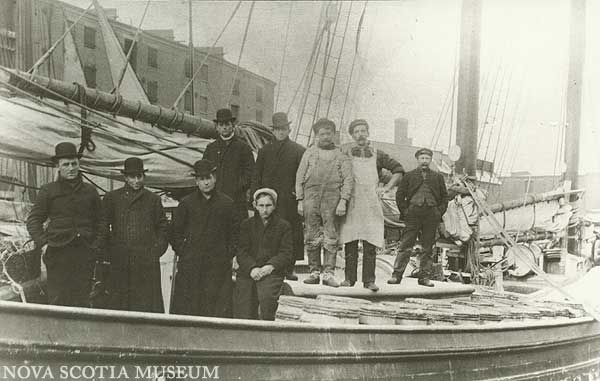
Image courtesy of the Nova Scotia Museum

Image courtesy of the Nova Scotia Museum

I’ve been pondering, wondering and worrying about how to bring value out of ITANA.org to the world at large.  I struck upon a metaphor over dinner with a friend at EDUCAUSE recently that brought my vision and the issues I’m pondering into sharp light for me at least.


I watched Captains Courageous, a wonderful 1937 film with Spencer Tracy, recently.  This is a story about a spoiled boy who ends up on a fishing Schooner.  The schooner would launch dories with fishermen aboard them.  The dories would bring there catch back to the schooner where the fish would be processed and packed.  The schooner would then bring the catch back to the mainland and to the public.

ITANA.org spins up sub-groups that work on a topic.  These are the dories if you will.  ITANA.org and its sponsors, EDUCAUSE and Internet2, act like the schooners and the delivery systems on the mainland. 

If I take this as the operating principle for ITANA.org, then a variety of questions pop into my head:

  • How do I make sure those sub-groups have the resources needed to bring back a meaningful deliverable? 
  • Who should be, as it were, on the dory doing the fishing? (It’s my metaphor and I’m sticking with it to the end – Jim) 
  • How do I make sure that the delivery from the sub-group to ITANA.org is a smooth as possible and as efficient as possible? 
  • How do I make sure that the sub-groups are working in fertile fishing grounds?
  • How do I make sure that what we are delivering is what the mainland wants?

These are the things that I’m wrestling with as I get ITANA.org up and running.

I see a lot of interest and potential in the bright minds that participate in ITANA.org.  We have great conversations.  We generate interesting thoughts an comments.  Those thoughts and comments get lost in the minutes from the phone calls or the hallway chats or the blog posts and notes from meetings.  How do I turn those things into more meaningful deliverables?

Some thoughts that I’ve had on this topic:

  • Each sub-team should have one person dedicated to gathering up content.  They should pull responses out of the minutes and into a wiki page or section.  They should glean the good stuff from the email chatter and add it to the wiki.  They would be responsible for rolling-up all the various bits and pieces that go by into a single reference point.
  • Each sub-team should have a set of deliverables as part of its charter.  For example, the Data Management sub-team agreed to deliver a survey and the survey results.
  • Each sub-team should produce some artifact(s) that can be shared with the world at large (e.g. a paper, or video or blog post) that others can consume on their own time.
  • I/we should have a standard way of “publishing” these deliverables and a standard set of ways of getting the news out that they have been published.
  • We should also be creative in our thoughts about how we engage beyond the core of ITANA.org.  Where does Twitter, Facebook, LinkedIn, the EDUCAUSE blogs and wikis, podcasts, screencasts, vodcasts, etc. fit into the mix?

That’s what I’ve been pondering.  Anyone have input?  I’d love to hear it.

Technorati Tags: , , , , ,

Brick Diagrams and related planning tools


Brick Diagram

Brick Diagram

Brick diagrams are a strategic planning tool that I mentioned in passing in my ITANA talk at EDUCAUSE.  Since then, I’ve had several people ask for more information.  So here it is… more information.


Brick Diagrams are used by NIH in their Enterprise Architecture planning process.  You can see the NIH brick diagrams and their taxonomy for the brick diagrams on the NIH EA Site.

Other institutions use similar planning tools.  Read on to see links to other places that use something similar and to download slides for a talk about Brick Diagrams that I gave to our Management Team.

Continue reading

SOA from the Registrar’s Perspective

Just had a hallway (okay, exhibit floor conversation) with Tom Black of Stanford University.  They have ideas on embedded enrollment functions in several places: inside their LMS, available via iPhone applications and elsewhere.  They would expose those enrollment functions as services then write to those services.  Interesting.  We also talked about orchestrating a flow, click on the drop button and you are passed to a short survey to see why you dropped.

This brought me back to the question in our session “Is SOA DOA?”.  I was asked how you get business leaders to buy into the SOA change and how do you get campus consumers to agree to work on SOA solutions.    Add to this the discussion with Karen Hanson, our Associate Registrar, on funding issues and how do we deal with costs of deploying SOA solutions.

It seems that there is a lot of interest in SOA in the Registrar’s world.

We may try to organize a meet-up after AACRAO in Chicago in April.  We could have Registrars bring their Architects for discussion around uses of SOA and issues with implementing, supporting and governing SOA.  It would also be good to hear their interesting Case Studies of how they are using SOA .

Things to follow-up on when I get home.

Technorati Tags: , , , ,

CG Leaders Meeting @ EDUCAUSE 2008

Introductions of people.  A lot of interesting constituent groups that I didn’t realize existed:  I.T. Metrics, Learning Space Design.  http://www.educause.edu/groups

Cynthia Golden – VP for EDUCAUSE is doing the EDUCAUSE update.

There was a new President last year.  They have been doing a lot of change management over the past year.  There is a new look-and-feel.

“Uncommon Thinking for the Common Good” is the new tag line.    “It’s not about information or technology. It is what we do with them that counts.”

EDUCAUSE this year is 10 years old.  They did a lot of information gathering this year – focus groups, surveys and webcasts.  Feedback: EDUCAUSE as an organization brings I.T. leaders and decision makers together.  It elevates the idea in the tag line.

Things they heard:  Be a voice for higher education, stay ahead of the trends, influencer or creator…

Diana Oblinger has an article in the most recent EDUCAUSE Quarterly.

Areas of focus: 

  • Teaching and Learning,
  • Managing the Enterprise,
  • E-Research and E-Scholarship,
  • Evolving Role of IT and Leadership

They are working towards more interactive sessions (Point-Counterpoint sessions), lighting rounds, innovation showcases.  They want to provide greater support for informal networking (informal spaces, powers stations).  And, they are focusing on sustainability – self-selection of tote materials, carbon offsets.

Peter DeBlois update on the program participations.

Grown by 5 CGs.  Increased subscriptions by 16%.

Project Management was a new CG two years ago and they are now in the top 10.

The 5 new CGs:

  • Emergency Communications (130 members)  – focused more on the technology
  • IT Communications (165) –
  • IT Metrics (164) – want to find standard metrics and working on ways to implement the ways of gathering the metrics.
  • Openness (106) – Covers Open Source Software, Open Content, Open Decision Making.  It is a broad scope from the very technical to very high level discussions.
  • Virtual Worlds (128) –
  • Women in Higher Education IT will start after this meeting

CG Leadership Ideas – Issues and Concerns

How do you stimulate discussions?  Put compelling topics on the table. 
How do you glean out the useful discussions and move them to another deliverable?

Ask each year if the group wants to continue to exist. 
Task multiple people to drive a topic area of conversation.  Tie this to deliverables.
Contacting people behind the scene to ask them to provide more information to the list.
Try to align a topic on the list with a conference submission.
Going to try to Skype out their CG meeting to reach a broader audience who cannot travel.
Trying some new media approaches.  They weren’t too keen on the idea.

Corporate and Media Participation:

Seems to be in control.  People are worried most about media taking quotes off the list and publishing them.

Adobe Connect et al:

They now have Adobe Connect licenses that the CG could use for on-line meetings.  You can have 1500 users.  Voice-over-IP with slideshows and raise-your-hand chat for questions.  We don’t have a toll-free number to call into the conference.  It is all VOIP.  It has capture and stream capabilities.

Interested in using this, send an email to Catherine Yang.

Surveys:

They have looked at an institutional Survey Monkey account.  It would be good to have an archive.

Other ideas:

Spotlight a CG every month or so to help promote the CGs.
Have library interns work on pulling together content from the email lists.
There is interest in regional CG meetings.  They are working out the details of how to facilitate that.

Technorati Tags: ,

Riding East with Cranes

from Flickr: KeithCarver

from Flickr: KeithCarver

I was riding on a late Summer evening in September and this is a meditation upon a few minutes in that ride.

If you are not familiar with the hills and valleys of Southwestern Wisconsin, let me describe them.  These are old mountains, the Driftless, worn down over the aeons by rain and snow. These lands have the soft folds and rolling landscape of a glacial moraine.  They are soft and round.  They are not miles broad like the Williamette Valley in Oregon nor are they ringed with rocky peaks like the Snake River Valley in Idaho.  They are gentle valleys with corn, soybean and dairy cows in their soft bellies.  Their tops are fringed with mixed hardwood forests: sugar maple, paper birch, ash with evergreen pines and firs mixed in to form dense canopies above a thicket of lower story growth of ferns, berries, wild rose and wildflowers.

The farmlands are broken with prairie and marshlands, hedges and woodlands.  Prairie grasses grow as a tall as your shoulders in places.  Prairie flowers; asters, milkweed, sunflowers; sway with dense heads of yellow or purple blooms, snowy white masses, delicate pink miniatures or blooms the size of your head.  The prairie plants have deep roots below ground that nourish their rich and dense lives above.  The marshes are fringed with willow, dogwoods and cattails.  Lilly pads float on their surface and irises sink their roots in the muddy shores.  Tri-Color Blackbirds cling to the tops of the reeds and grasses and call out for their mates.

You must imagine these hills with woods on their tops and shoulders and corn, soy, cows, meadows and marshes flowing down their valley floors.  Picture them clearly in your mind.  Row upon row of rectilinear corn where the land is flat or arcing along the lines of the geography where the land rises up the slopes.  Small, upright soy beans turning yellow in late Summer. Alfalfa forming a dense green field between tall yellowing corn stalks.  Milk cows, mostly, chewing and lazing in grassy fields.  A farm house and its corn crib, barn and silo gather under a stand of trees every once in a while.

Form these images in your head. They are the backdrop for these few minutes that I’m about to describe.

It was a beautiful late Summer/early Fall day. It was still shorts and short sleeve weather but not by much.  Warm Sun on my back, cool early Fall air on my arms and face.

I rode out, first north-west, across the country side that I described above – out to Fish Lake and Mud Lake.  I turned and started running back East along the southern shore of Crystal Lake back towards Lodi.  The sun was low in the West, three fingers off the horizon if you hold your arm out straight. 

Now imagine: The road side is thick with willows, sage, prairie rose that is thick with bright hips, late Summer prairie flowers and all of it buzzing and chirping and humming with insects that are making their last pitch for a mate before the frost comes.  The left side of the road rises up in woods and understory plants.  The first Fall colors are coming on in the wild grape vines that climb the trunks of the old oaks and ash to weave through the canopy in search of Sun. The low dense stands of sumacs, huddled along the edge of the woods, are turning rust and cranberry and burnt umber. I spin along these colors and sounds with the Sun on my back and cool air in my face and on my arms.

The valley runs along my right side with open fields of prairie grass and late flowers.  A river turns and dives, back and forth, through the flat land forming marshes with reeds and willows.  Below, in the valley grass, I hear the call of Ringed Neck Pheasants then the thrumming beat of their wings. I spin with their thrum.

The sun is flashing low up through the valley, glinting on the river and then tumbling up through the prairie plants and into corn and soy.  I’m spinning my way along the road.  A flight of Sandhill Cranes rise up out of the marshes down below with their squawking coo.  First one crane… then three… five… eight… soon twelve cranes are on the wing in the valley beside me.  They rise up eye level and match my speed running East.  They coo and squawk. The Sun, three fingers above the horizon, glints off the marshes and tumbles through the prairie.  The bushes are buzzing and humming and chirping with insects.  I’m spinning my way East in this late Summer afternoon and cranes are the wing to my right and the Sun is on our backs and cool air in our faces.  And I spin and they soar and call.  And we move together for a minute, two, then three before the cranes turn on wing to the South and head out towards the corn and soy.  And the Sun, three fingers off the horizon, glints off wings and water and tumbles through prairie and corn and warms my back as I spin on and away to the East.

I spin and smile at the wings beating South and the river turning and diving and the Sun glinting off the marshes, and humming and buzzing and chirping.

I spin and smile at these few minutes when I was traveling with the cranes through this late Summer/early Fall evening.

Technorati Tags: , ,

Door County Century Recount

One week after the Door County Century (nearly) and I’m finally getting around to writing about it. In short – it was a great ride, a wonderful cap-stone to the cycling season; but I’m jumping ahead.

The night before, Erik, Monica, LeRoy, Ena, Barbara and I had dinner of a lot of spaghetti and bread sticks and wine. Erik had picked up the latest weather report and it looked a bit sketchy: cool in the morning (54 F) with winds out of the West. We would ride into those winds then have them off of the bay and over our left shoulder for the next 40 miles. Then the winds would turn and come out of the south west (into our faces) and bring rain. It wasn’t supposed to get very warm either (62 F). Cold morning with wind off the bay, cold and raining afternoon with wind in our faces. Bleach.

The prognosticators were wrong and we had a beautiful day. We had gorgeous sun and perfect weather almost all day. But I’m jumping ahead again. We had a few miscues getting to the start but finally hit the road at 7:40AM – about 30 minutes later than we planned.

20532058206220662070

We met up with a group of riders (Bradely, Jim, Dean, et al) who were well matched with us. We switched off pulling with them and had a great ride through to the second rest stop. It was great fun pulling a line of 20 or so riders along the bay.
20742078208220862090209420982102

Barbara, Ena and our dog Lola met us at the second rest stop so we could drop cold weather gear for the rest of the ride. It was great of them to chase us around Door County. They were great sports and that made the ride a lot more fun. Lola knew how many riders were in our group and she would check until she found us all at each stop.
210621102114211821222138214221462150

By the last leg, it was often just the four of us pulling together. The weather was beautiful and the route was very nice. We all finished together as a group.
215421582162

It was a great ride on a beautiful day.

Here are all the photos and a link to my Garmin data from the ride if you really want to geek out.

2166

25 MPH on a Cargo Bike

I had an 8:30 AM meeting this morning, it was raining and I was running around looking for my rain gear (helmet cover, shoe covers, leg warmers, etc). It was 92 degrees F yesterday – the warmest day of the year. This morning, the remnants of Gustav rolled into town. They will go North with me up to Door County for my century ride on Sunday but that’s another story.

I finally race out of the house running about 10 minutes behind when I should have left. I get on my bike and I start cranking it out to get into work. I see a guy (Mike it turns out), riding past the house on a cargo bike.


He is going North on Gilbert (which runs on the West side of our house). I head out East on Dorsett. We are traveling perpendicular paths to each other. I turn left on Luan and I see Mike on Hammersly. I turn right on Hammersly and Mike is ahead of me also heading for the South-West bike path.
We climb the fly-over and head out on the trail proper. I pass him on the flats and say, “Good morning”. He says, “Good morning”. I ‘m still cranking away because I’m running late. I get to the first stop sign and I realize that he is in my draft. He says, “You’ve got fenders so I can draft properly” and we both laugh. We get a break in traffic, both cross Midvale Blvd and take off. Mike pulls out in the lead like he is going to pull for a while.
First off: this is strange. I get a lot of people who suck my back wheel into or out of work. Rarely to they swap leads with me.
Well, I’m glad for the help because it is raining and I’m late. He pulls for a while, I swap and take lead and cruise to the next stop. We cross Odana and Mike pulls out. I start to chase him down to get in his draft but he is flying. I look at my computer – 25.3 MPH. “Man, this guy is cranking on a cargo bike. He must be a monster.” I pull out the stop and get in his draft for while then it is my turn to take lead. I pull out around him.
(I will say that he looked surprised when I took the lead again.)
I’m thinking to myself, “well, if he is going pull us at 25 MPH, I’ll pull at 25 MPH.” I’m on my commuter bike with full fenders, a rack and a 12 pound pannier with lunch, change of clothes and all my miscellany in it. I’m working hard but if we’re going to do a 25 MPH pace, then dammit, I’m going to take my pull.
Suddenly Mike (as I later learn his name is) pulls along side and says, ” You do know I’m cheating don’t you? I mean, I hate to let people think that this is all human power. Have a look down there.” He nods his head, pointing back behind his legs. I look down. He has an electric assist motor. It provides 100-300 Watts of assist to his pedaling!
Ha! I’m killing myself to pull a guy with a motor. He does do a long commute as I learn (about 15 miles each way).
We had a good laugh and a good chat on the rest of the way in.
That’s what love about bike commuting – the laughs and camaraderie.