Author Archives: jimphelps

Unknown's avatar

About jimphelps

Chair, ITANA Enterprise Architect, Sr. IT Architect; UW-Madison

E!Live Webinar on Digital Transformation

I was on a panel with Jennifer Sparrow (Penn State), David Weil (Ithaca College) and the EDUCAUSE staff to discuss the Digital Transformation (Dx as they call it). You can see the slides, read the transcript and (EDUCAUSE members) can watch the webinar at the EDUCAUSE E!Live site:

EDUCAUSE Live! Webinar Digital Transformation in Higher Ed: What Is It, and Why Should You Care?

Future of Higher Education – Our Response to Disruption – Presentation at EDUCAUSE Annual 2018

I presented at EDUCAUSE Annual 2018 on the Future of Higher Education in the US. The presentation talks about four big drivers: Shifting Skills, the Digital Transformation, Income and Employment Challenges in the American family and the Higher Education Financial Crisis. For each of these drivers, I suggest a set of responses. I then paint a picture of a future Higher Education institution that has responded well to these drivers. You can download the Playbook and the Presentation from the EDUCAUSE Site.

Future of Higher Education – Our Response to Disruption – EDUCAUSE Annual 2018

The presentation and playbook are downloadable as PDFs below:

Scenario Planning and Job Pathways – Two tools to help you plan your career.

I recently published an article in EDUCAUSE Review on using scenario planning and job pathways to help individuals think about their career plans.  I suggest starting with scenario planning, with a focus on changing skills and how the workforce needs to adapt, to get a sense of possible future skills and careers.  This acts as an input into Job Pathway planning where you look at career steps you could take and the skills needed to take each step.  Here is a link to the article if you would like to read it in full:

Scenarios, Pathways, and the Future-Ready Workforce


Architecture and finding the path

Ron Kraemer, our VP of Information Technology and CIO, spoke at the IT Leaders Program this week. He built on his blog post, Interdependence – Both Positive and Negative. To paraphrase:

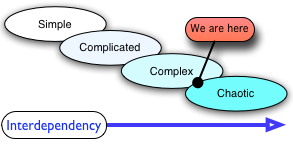
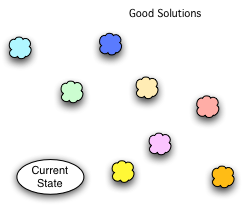
The growing interdependence of our systems is driving the complexity of our systems towards the edge of chaotic systems. The choices that we make are no longer focused on finding the perfect solution. Instead, we can see many possible solutions, many of which are good solutions. The choice is then to pick the solution which builds positive interdependency and limits negative interdependency.

Interdependency and Complexity

Fig. 1: Growing interdependency has put us at the edge of complex and chaotic systems.

In his talk at ITLP, Ron also pressed on the ever-growing rate of change. These two factors limit our ability to design and implement perfect solutions to problems. To paraphrase again:

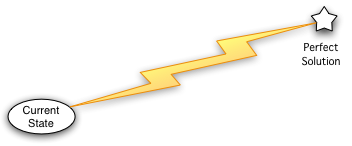
If you take two years to design a great solution, the landscape will have changed so much that the solution may not be applicable. The level of complexity makes finding and defining the perfect solution even more difficult. The level of interdependence means that even more good solutions are available – when many systems are connected, many systems could be used to provide the solution.

Impossible Route to a Perfect Solution

Fig. 2: Impossible Route to a Perfect Solution

I agree with what Ron has come to believe. The level of integration between systems is very high. The expectation for real-time interactions has become the norm. Users expect to see real-time flight information. They expect real-time updates on openings in courses. Students can see, in real-time, the bus schedule, where they are located and the location of nearest bus stop and the location of the buses on their routes.

This interdependence has driven complexity to the point where perfect solutions are hard if not impossibly to design and deploy. Therefore, we must choose from many good solutions that exist. We need to act quickly to implement some solution to meet the rapid rate of change.

Many good solutions

Fig. 3: Many good solutions

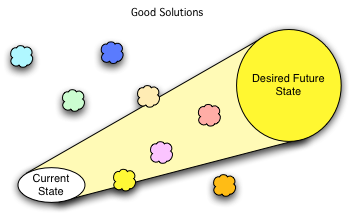
This is where Enterprise Architecture and the other architecture practices can help. If we look out to the future and think about the desired state, then we can begin to sift out those good solutions which move us towards that future state. For us, we had stated that Service Oriented Architecture was a strategic direction. That bounded the future state some. In the student area, we had a future state process diagram. This diagram outlined improvements to the way that students manage course data and move through finding courses to enrollment. This put another boundary on the future state. When it came to think about how we get course roster type information out to a new learning management system (Moodle), we were able to use that projected future state to pick from the possible solutions (flat file transfer, shared database connections, web services) those which moved us closer to future state.

Architecture filtering the good choices

Fig. 4: EA can help filter the good choices that move you towards the desired future state.

The rate of change and interdependency drives the importance of an architectural approach. If you have not thought about the future state, then there is a multitude of choices. To pick from many choices, you have to establish some factors that affect your selection. In a restaurant, this might be dietary restrictions, cost, the weather outside. In technology, it is often quickest and cheapest. But those factors, in this complex environment are often shortsighted and misguided. The quickest and cheapest solution might need to be replicated many times for many systems. This would increase the interdependency in a negative way and push you even closer to a chaotic system. A more expensive, slower solution might serve you well over the long haul.

Architecture can help you make those choices in a framework that is focused on the future and on the overall complexity that you are creating. Enterprise Architecture (and the other architecture practices) can help sort those good solutions and help make sure the choice you make is along the path to desired future state.

What’s the rush America

My long lost then found friend, Jenn Taylor, just moved back to the United States. She asked the question, “what’s the rush? I am just curious beyond words as to what brought this culture to this rapid speed and the underlying sense that we are always in a hurry. Such a rush. Always a rush.” Here is my long(er) answer to her question. I think the American rush is due to four different phenomena acting together.

First: Many Americans seem to have lost the ability to focus on one task at a time. Multi-tasking is the way to do everything. If you are watching a movie, you should also be texting or talking on the phone (at home or in theaters). If you are driving, you should be eating or talking on the phone. What ever you are doing, you should be doing something else.

Second: Many Americans view driving as not an act in and of itself. It is something stuck between two meaningful things. Get ready for work. Be at work. Driving just needs to be gotten out of the way. It shouldn’t occupy time. The act of driving to work isn’t something to appreciated as part of your day. It is like swallowing medicine. It should be done as quickly as possible and not thought about.

Third: Many Americans lack critical thinking skills. I was riding with Joe down to Paoli. We were coming up to a stop sign. At the stop sign there was a line of cars stopped waiting to turn onto a busy road. Joe and I slowed and moved side by side to chat as we coasted up to the stopped cars. An old man in a Toyota RAV 4 blared his horn at us, punched the gas and blew around us at the left, then swerved hard to get in the lane and slammed on his brakes to stop behind the stopped cars at the stop sign. What did he gain? Absolutely nothing. Joe and I coasted up behind him and just laughed at him.

Where is the critical thinking in these moments? What do I gain by my actions? What is the overall effect? Is it really worth it? Many drivers change lanes constantly even though studies have shown that you gain nothing.

I was in the grocery store and there was a woman pushing her daughter in one of the carts that have the fake car on front. The daughter was mimicking Mom, pounding on the horn in the cart and saying, “We don’t have time to stop. I’m in a hurry. Not today.” What did the Mom gain by always rushing her daughter away from things? What was she teaching her daughter? What would the real outcome be if she did slow and stop for her daughter some times?

I’m sure these questions never crossed her mind.

Finally: Americans seem to have lost the sense of civility and the idea of the public. Our Alderperson argued against light-rail on the fact that it wouldn’t stop in front of her house. (You may be for or against, that’s not the point). The idea that there are things to do for the good of the whole rather than personal gain seems to be gone from many Americans ideology. “If it doesn’t help me, I’m not paying for it” seems to be the new American mantra.

I think all these things come together into a storm of rushing, self-absorbed, multitasking Americans racing from spot to stop without stopping to think about what they are doing or why.

SOA – Maturity is Key Presentation, EDUCAUSE Enteprise 2009

My presentation on SOA in the Enterprise – Maturity is Key has been posted in a couple of places.

First, on the EDUCAUSE site is the talk listing:

EDUCAUSE – Enterprise 2009 Site

Slides can be found at Slideshare.net:

John Peterson – Rememberances

prayerflags1
I learned that John Peterson, our Director of Systems Engineering and Operations, passed away yesterday evening.  I will miss John.  I can still see the sideways, quizzical glance and smile he gave me yesterday afternoon as the vending machine spit out 4 dollars in quarters.  I can still hear his voice as he said to someone else down the hall, “he just hit the jackpot”.

My first memory of John was from my first Management Team Meeting seven years ago.  There was general talk about planning and John popped off, “The mainframe will be going away July 1st.”  Everyone laughed and looked at Jack Duwe, our Deputy CIO and CFO.  I later learned that the mainframe was going away every year since John came to DoIT.  During the seven years we worked together, John replaced the mainframe with a new improved mainframe three times.

John had a great, level-heaed, realistic management style.  He told a story about his days when he was a Flight Deck Commander on an aircraft carrier.  They had a broken catch wire.  The ship’s captain was yelling at John on the flight deck telling him to get the wire fixed.  His guys were doing their job and fixing the wire.  The captain kept yelling to hurry up.  John looked up to the control tower where he could see the captain looking at him, took the battery out of his headset and flicked it over the side of the ship.  He tapped the headset and shrugged.  “Yelling won’t make a problem go away and it rarely makes it any better” he said about the incident.

John was a great story teller and he had a rich life of stories to tell.  I enjoyed when he would recount his days flying fighter jets or as a commander.  He told me once about racing to get to a dentist appointment.  He had a broken tooth and he didn’t want to miss the appointment.  It had taken him weeks to get in and it would be weeks before he could get another appointment.  For you or me, that means driving across town.  For John, that meant jumping in a fighter jet and flying to another city.  He got to the airport and was waiting to take off.  The air traffic controller told him that the approach lanes were all stacked up with flights.  There was no way to get him out of the airport and to his cruising altitude and cruising lane.  John asked, “what if I get to my altitude within the airspace of the airport itself.”  He really didn’t want to miss the appointment.  The controller said, “that would be fine but there was no way to do that.”  John said, “don’t worry, I’ll do it.”  He took off and hit the afterburners and headed straight up to 30,000.  He laughed because he could hear the controller over the radio saying, “Holy crap… Jesus…  look at that…”  “I really didn’t want to miss that appointment,” he said laughing and shaking his head.

I enjoyed running into John when he would take his flotilla of misfit dogs out to run.  He would pull into the parking lot in his SUV and dogs would pile out.  One old deaf cocker would just keep wandering off until John had to run after him.  One lab took off and John looked for hours trying to figure out where the dog had gone.  But John always stayed level headed in the mix of all this.

What did I learn from working with John?  I learned that you stay calm in the midst of adversity.  I learned to listen to the story and laugh with joke but also listen for the wisdom that the story holds.  I learned that there is the path forward that is obvious to you but that you must have patience while it becomes apparent to others.  Mostly, I learned that John was a great man to be around.

Rest In Peace John.  You will be greatly missed and well remembered.

Quantifying Me


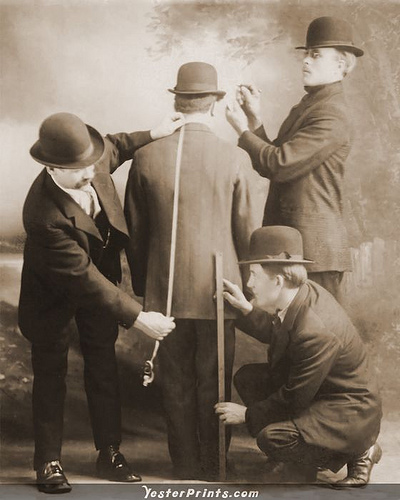
from Flickr: Yester Prints photostream

from Flickr: Yester Prints photostream

There is a meme that has popped up or, at least, it has suddenly popped into my world – the Quantifiable Self.   The basis of the Quantifiable Self is that you measure things about yourself and then use that data to improve upon yourself.   We all do this to some extent.  We weigh ourselves daily or time how long we run and over what distance.    Some count calories or count steps. 

Some push this to great detail to track influences on complex diseases like migraines.   Alexandra Carmichael tracks 40 things about herself daily. There is (of course) a site dedicated to the Quantifiable Self.   

I already track a great deal about myself but I don’t measure the out-comes, the effects if you will, of all that I track.  The Quantifiable Self people are looking for the little butterfly wing beats that cause the tornados in their lives. To do this, I would need to resolve three issues.

Continue reading

12 Seasons


Flickr: Jorge-11's photostream.  The Prague Orloj

Flickr: Jorge-11's photostream. The Prague Orloj

Scott Fullerton once worked as a choker-setter in Northern California.  He pointed out to me that we really have 12 seasons and that 4 seasons don’t really capture the nuances of the slow changes in nature.   Since I’ve been bike commuting I have come to recognize those 12 different seasons.


Winter starts with Dark and Bleary Winter.  This micro-season, if I may coin that term, starts about mid-December and it runs to mid-January.  The Sun sets at 4PM and rises about 9AM it seems.   Once it does rise, it scoots along the Southern horizon so low that Noon sunshine ducks under the eaves and in our front bay window, scuttles across our living room and settles on the floor half-way across our dinning room.  The Sun, during the brief period it is up, has as much warmth as a nightlight.  We all start running low on vitamin D and cheer.

Dark and Bleary Winter is followed by Bright and Chilly Winter.  This is the season we are in now.  Bright and Chilly Winter runs from mid-January to mid-February approximately.  The Sun is higher and actually caries some warmth.  Daylight is returning.  Today, we will have 10 hours of daylight.  There is light in the western sky at 5PM when you leave work.   We still get thrust into the deep freeze by the “Polar Express” – cold winds that come down from the Arctic Circle, unfazed by the expanses of Canada, to land in our back yards.    But there is Sun and deep cold is more tolerable when the Sun is more courageous.

B&C Winter is followed by Sloppy Winter.  Sloppy Winter is full of melting snow that refreezes and heavy wet snow that falls and gets instantly packed into ice.   There are brief periods of brown and gray followed glop then cold once more.   Sloppy Winter is the Winter of our discontent.  It is the Winter when you start thinking, surely Winter will go away soon only to have another 6 inches or 16 inches of snow fall and the temperatures plummet again.  

Sloppy Winter lingers until mid-March when it gives way to Brown and Muddy Spring.  You can see the plants are starting to wake in Brown and Muddy Spring.  You see the fine light-green haze of buds that are just waiting for the nights to warm a bit more and Sun to gain a bit more courage.  

There is one day, early in Brown and Muddy Spring, when you are out and you smell the warm rich smell of damp earth.  The ground has thawed and a warm wind is coming from the Southwest up from the Gulf of Mexico.  You smell damp earth and you realize that winter seasons have passed and you also realize how much you have missed the air smelling like some warm and liquid.

The very earliest of plants start poking their tendrils out.  The early Spring Crocus decide to make their move along with Snowdrops and a few of the most courageous tulips.  The song birds start to return.  This is a time of migration – warblers and sparrows start flying through bring bright songs to the hedgerows.  

It is also time of migration for the last of the snow and mud.  Snow begins its retreat leaving a muddy tide behind.  All of the sand and grit and car parts that have been bound up through all the Winter seasons are left behind on streets and parking lots and lawns in miniature glacial moraines.  Dog toys, not seen since December, reappear in a sodden and forlorn heap.  Brown and Muddy Spring is the first promise that the Winter seasons have actually gone.  There is one more snow storm, wet and heavy, that will bend over daffodils and flatten the crocus but it will melt in a day or two.  The Sun has now girded its loins and it is ready to face another year.

Then comes Kablooie Spring about mid-April and through mid-May.   All that pent up energy that has been stored up in frozen soil suddenly explodes out through every branch and twig, bulb and root.  Lilacs, Forsythia, Magnolia, you-name-it, it is now game-on for the Spring blooming plants.  Mid-April to Mid-May the air is sweet with spring flowers.  The birds are singing their heart’s devotion to each other.  The spring peepers and letting the world know they survived the Winter and water is fine.  

This is Spring.  When one thinks of Spring they think of Kabloooie Spring.  The bunnies are out and frisky.  You see your neighbors our in their yards and you stop to chat and recount the events of the various winter seasons.  When you are in the midst of Sloppy Winter and you think, “Enough of this muck!  I can’t wait for it to be Spring”, you are really wishing for Kablooie Spring.

But we are in Bright and Chilly Winter now.  B&C Winter brings days when we never get above zero degrees (F) but they are tolerable and even enjoyable because the Sun is high and shining.  It also brings days like yesterday.  

Yesterday was sunny and a warm 40F.  Yesterday was a day that you think about opening windows or sitting outside on the porch in the glider and reading.  Yesterday was day that can make you think that Kablooie Spring is just around the corner.  But, it is wise to remember that there are two more seasons before we get to celebrate the arrival of Kablooie Spring.

The Pattern of Change


Stepping

Stepping


I just watched a Merlin Mann’s presentation from MacWorld – “Toward Patterns for Creativity”  This is not his best talk but it is interesting and amusing in that Merlin Mann way.  You can tell that he is in the “there is something good here but I haven’t quite got my head around it yet” state.  This is a state that I stumble through often in my work.  I learn about a new technique or start to see a new pattern and I can tell that there will be a richness eventually but I haven’t quite grasped the fullness of the idea.  All of this is beside the point.

The point that struck me from his talk was towards the end.  It came near this slide:


From Merlin Mann's talk on Patterns in Creativity

From Merlin Mann's talk on Patterns in Creativity


Merlin made a comment that if you want to get better at your creative endeavor, “you have to work at it and that means less time on Twitter or playing X-Box”.    This is a way of restating the cliche that defines craziness as doing the same over and expecting different results.   If you want to change something in your life, then you need to change what you are doing now.

This is something that I should make more explicit in my life.  I have several personal goals that I’m working.  To achieve them, I need to realign my activities and energies.  Doing what I’ve always done won’t cause the change that I want to occur.

Painting:  

Over Christmas / New Years break I set up my watercolors again.  I’ve really enjoyed painting and creating art again.  I want to improve my skills and my creative vision and push to find my own style.  I cannot do that if I continue with painting the way I have for the past decade which is to occasionally set up and paint a picture or two then put everything away for a year.  I need to set some goals then stop doing something else to make time and space and energy for painting.  

My goal is pretty straightforward – create at least one painting a month this year.   Not very difficult in these Winter months.  This will be much more difficult come Summer and hours when I want to spend my time my road-bike cycling around Southwest Wisconsin and on trips or to take Lola swimming.

The realignment:  less mindless TV in the evening during the week getting my sketches done,  more quality time at the easel on Saturday  or Sunday morning.  

Interesting outcome:  less TV means less desire to buy a new 52″ LCD TV and more listening to music while I draw and paint.  I’m saving money and rediscovering my CD collection and new music.

Weight Loss:

When I lived in California, I gained a lot of weight.  I have gradually lost about 25 pounds of that weight.  I’ve manage to, so far, not regain the weight I lost last Summer when I was cycling.  Okay, this is mostly true.  I dropped 10 pounds last Summer and I’ve gained back 2 or 3 so far this Winter.  I’m fine with that trade:  loose 10 over the Summer gain back 3 over the Winter.  At that rate, I’ll be at my target weight in 18 months.

My goal is to get to 175 which would put me at a good body fat percentage.  

The realignment:  Personal Training twice a week.  Weight lifting at home once a week.  And, lot’s of time on my bike when the weather changes.    This means less time working on the yard or house, playing with Lola and watching mindless TV.  This will be in direct conflict with Painting.  I’m not sure how I will reconcile the conflict with Painting.  I feel badly about less time playing with Lola.

The realignment also includes changes in what I eat.  I love breads and cookies.  I adore cookies.  I also enjoy cooking a wide variety of foods.   I am explicitly changing to a more vegetarian diet.  I’m not becoming a vegetarian – I enjoy being an omnivore.  I’m eating fruits and vegetables that are local when possible from our incredible Farmers Market.  I’m following Mark Bittman’s advice and reducing the size of my meat servings and their frequency in my diet.  I have greatly reduce the refined carbohydrates in my diet.

This brings up another interesting conflict.  Eating carbs is good for working out.  Not eating carbs is good for weight loss.  Eating fiber and protein and fat is good for feeling full and staying satiated though-out the day.  Eating fiber, protein and fat before a workout can make you want to puke.  Trust me on that one.

Interesting Outcome:  increased strength, endurance and flexibility make me feel more vigorous.  I sleep soundly at night and I have more energy during the day to work on my other goals.  I find that sitting and watching mindless TV makes me twitchy so I want to do something rather than just watch something.

Cycling:

Last Spring I bought a real road-bike.  This is first real road-bike I’ve owned since I rode the canyons of the Wasatch range in college.  I own and ride my commuter bike a lot but a road bike is a different animal altogether.  I loved my Summer of cycling in 2008.   This year I want to continue with my cycling and take it up a notch.  Last Fall, we rode the Door County Century – a 100 mile ride.  This Fall, I would like to ride a double metric century – a 200Km ride or a 124 mile ride.   I would also like to move my average moving speed up at least 1 MPH. 

The realignment:  I spent a lot of time in the saddle last Summer.  Towards the end of the season, I was riding 12 to 14 hours a week.  I don’t think I can get more time on my bike so I will have to train more intentionally.  There is risk in taking on a more serious attitude towards training.  You can loose the fun of riding.  I had great fun exploring the hills and valleys that surround Madison by bike.  I have to tread cautiously here.  I have turned cycling into a evaluation of numbers and made great rides bad because I wasn’t hitting speed goals.  So I caution myself to not turn the joy of biking into serious work that full of disappointments of milestones not met.

Interesting Outcome:  Improving my fitness and technique would increase my average speed.  Longer rides would take less time.  I would, in effect, free up time to do other things like play with Lola or paint or work in the yard.

Being explicit in the changes in my routing is what Merlin made me think about.  Truly focusing on “that is what I used to do.  This is what I should do now if I want to reach my goal” will be my challenge.